Thursday, 24 September 2015

Macro Diffuser Prototype for the Mirrorless System

Ever since I posted an article on my lighting and diffusion techniques for the mirrorless system, there have been many requests for a step-by-step tutorial on how i make my diffuser.  I wasn't able to fulfil these requests immediately simply because I didn't want to rush the process - I have actually been working on a better diffuser and I really wanted to test it out first before sharing the "goodies" on the internet. I have been tinkering with various diffusion materials as well as diffuser designs over the past few weeks and I think I might finally have my first prototype ready.

Camera Body: Olympus OM-D EM1
Lenses: M.Zuiko 60mm macro lens with a Raynox dcr-250 attached
Flash-Unit: Olympus fl-14 flash
Diffuser: Prototype A

For more on these equipments, click here.

Here are some sample photos. Le me know what you think! * Please click to Enlarge*


A Classic Cosmophasis species - Tiny, Sparkly and absolutely fabulous! Legspan around 1cm or 10mm.


A very hard subject to photograph considering how tiny and sparkly it is. I am glad that my new diffuser was able to capture the details!


A tiny Thread Legged bug (Emisinae), a subfamily of the assassin bug that has raptorial legs like a mantis, found living 20 metres underground in an abandoned World War One Bunker!


 I only managed 2 hasty shots of this beautiful jumper because we had to leave the location immediately due to bad weather. Turns out that both photos came out rather OK! 


I am not too sure of the ID although I am pretty sure it is a gravid female!
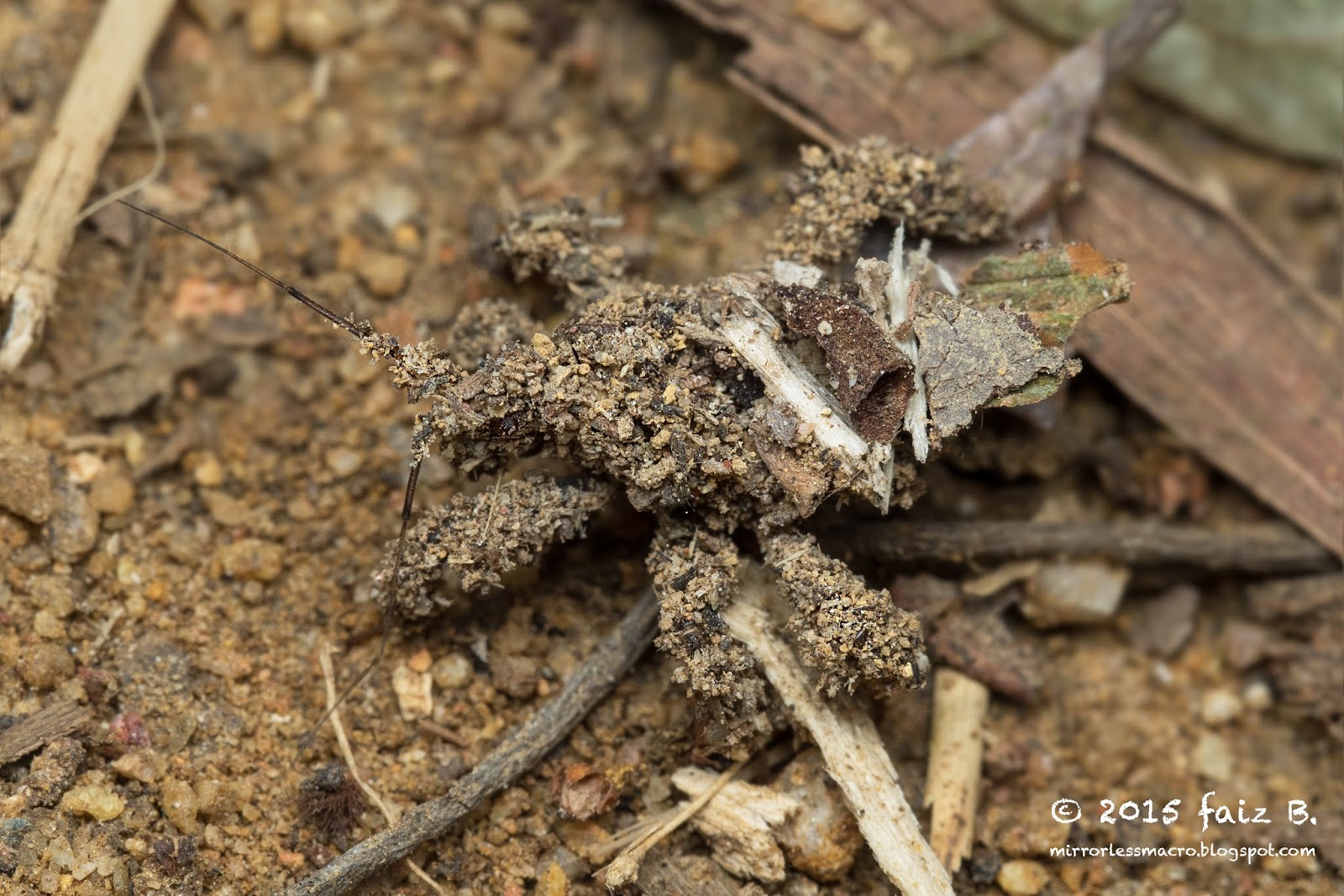

Can you tell what this is?


It is a nymph of an assassin bug (Reduviidae) that has coated itself in mud and sand, presumably as a form of camouflage! It was really going after the Derelict-look.


Now this is an interesting one. You have probably seen or heard about Rhinoceros and Rhinoceros Beetles but have you seen a Rhinoceros Spider? This is a male Thorelliola ensifera  (<5mm or 0.5cm),  commonly known as the Rhino Garden Jumper, that has a pair of tightly held horns on its clypeus. I have seen many photographs of this spider but very few that actually showcase this unique physical trait that lends it its name. See if you can spot the horn!


It was so tiny that i didn't know that it was actually feeding! I couldn't see the prey item in the viewfinder at all prior to reviewing on my my Macbook.


A mite-infested Big-Jawed spider (Tetragnatha sp).


It was hiding underneath a metal pipe which was right next to a heavily flooded monsoon drain.


Okay, not my best backlighting shot but it does show the 'insides' of this leaf-mimicking katydid nymph, Chondroderella cf. borneensis (1.5cm or 15mm). Kinda look like a shrimp, a leaf shrimp! For my tutorial on backlighting macro, please click here.


Beautiful bug with incredibly intricate markings on its back.


Possibly a beetle larva? Less than 5mm in length. It looks like a tiny brain.


I am pretty pleased with the catchlight on this diffuser given that this beetle is really tiny!


 Another Assassin bug (Reduviidae) with a striking coloration - To Hell with camouflage!


If avocado have legs.


A tiny cricket nymph (2mm) that made this algae-covered signboard its home. It looked like a speck of white dust with the naked eye but under a macro lens, it completely transformed into a gorgeous princess.. ( I am assuming its a she!)
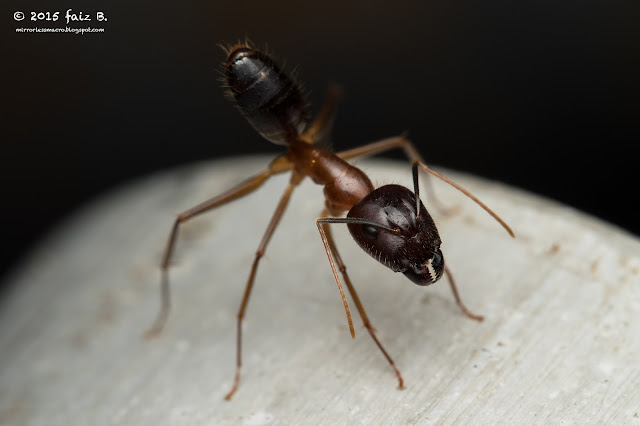

One of my favourite subjects to photograph besides spiders, and definitely one of the hardest, due to its size and light-reflective nature. I really liked the soft catchlight on this ant (Camponotus sp.)!


I bumped up the exposure compensation on this Diptera since it was hiding quite deep in the foliage.

-----------------------------------------------------

In conclusion, I definitely think that there is an improvement from my last diffuser. It probably needs a little fine-tuning but so far I am very happy with the results. Stay tuned for an in-depth tutorial, coming soon!


Sunday, 21 June 2015

Wide-Angle Macro

Wide-Angle Macro is a photography discipline where Macro meets Landscape photography. The focus is no longer just on the subjects but the surrounding scene as well, providing for a more intimate look into the lives of these amazing creatures. I have been experimenting with it in recent months and I would have to say that it is highly addictive, albeit, a pain in the *** to get right! Here are some of my shots.

 Shot taken with my Rokinon 7.5mm lens and modified Extension Tube.
Nephila sp. with Sungai Buloh in the background.
 We spotted this Kopstein Bronzeback trying to cross a patch of forest clearing so we took the chance to snap a few photos.
What a gorgeous snake!
One of my first few attempts at wide-angle macro. It is so hard to get the subject in focus!
A Katydid shot with Natural Light.
A  shot of a 'fingerprint' ant with fill flash.
This snail is probably less than 2cm in length and as you can see, it was really tough to get all of it in focus.
 A recent attempt of a Dead-leaf Grasshopper.
 Another attempt from a different angle and with a deeper Depth of Field.

It has been a pretty interesting (and tough) learning-journey thus far but I remain hopeful.

If you are really interested in Wide-Angle macro, do check out Gil Wizen's wide-angle macro shots here. They are rather amazing!

Friday, 12 June 2015

My TOP 5 Insects and Spiders Mimic!

The World of the Insect Kingdom is full of surprises and nothing is quite as it seems especially for us  gullible humans. Is that a Red weaver ant crawling on the leaf? And why is that leaf moving? Must be from the wind, you reckon. Seconds later, that "leaf" started to 'walk' and suddenly you find yourself questioning your own sanity.

Don't worry, chances are you have just seen a Leaf Insect.


A Nymph of a Phyllium sp. that mimics a leaf.

Oh, and that 'ant' you saw? Nope. It is an ant-mimicking Jumping Spider (Mymarachne plataleoides). Image on the right.

Surprised? Don't be. There are probably thousands of invertebrates that mimic other animals and plants and some might even be living right under your nose! These animals use Crypsis  (a collective term for avoiding observation from other organisms, which includes camouflage and mimicry) as a predation strategy or to avoid being eaten. So don't take it personally; They are not here to fool us humans for a couple of laughs. They are merely using what Mother Nature has given to live another day, find a mate and die happy. Whatever the motivation, one thing is for sure - They are all amazing!

Here is Part 1 of the Top 5 Insects and Spiders that mimic, all found right here in Singapore. Check them out!

Number 5 - THE FEARLESS, HOMODES BRACTEIGUTTA 

Despite the similar-sounding last name, this moth caterpillar has nothing to do with the famous DJ, David Guetta. This caterpillar, in my opinion, has ten times the cool factor compared to the latter with its brazen and slightly suicidal ability to mimic its role-model, a species of predatory ants called the Asian Red Weaver Ant (Oecophylla smaragdina).


Nothing escapes the wrath of Red Weaver Ants, ever. Not even a lifeless exuvium of a spider.
What a brave cutie.
This caterpillar is roughly the same size and it can often be found hanging out near the ant's nest. It is amazing to see these formidable ants move past the caterpillars without a hint of hesitation or suspicion. Pure luck? I do not think so. I have seen beetles and lizards being ripped apart by the Army ants for being too close to the nest. Good job, caterpillar! You made it at Number 5 on my list for being crazy and cute at the same time.

Number 4 - THE ETHICAL PRO, MYMARACHNE MAXILLOSA


Unlike the caterpillar at number 5, this spider from the Salticidae family, actually does look very much like its role-model, the Golden-Tailed Ant (Polyrhachis ammon). So much so that it actually fooled me the first time I went searching for them. It is almost perfect in its mimicry of the ants from a physiological perspective, considering that it is afterall a spider and not an intra-order relative.
Right: Here you can see a bed of pseudoscorpions feeding on a dead Polyrhachis ammon.
A female Mymarachne maxillosa. Notice how it raised its front legs to mimic the antennas of ants.
A male Mymarachne maxillosa with an enlarged Chelicerae. Note the shade of Gold on its body.

I have spent numerous hours in the forest studying these insects and from my observations, these spiders would generally avoid getting close to these ants and instead use its mimicry as a form personal protection. Like its Red Weaver cousins, these Golden-Tailed ants are fearsome predators and would not hesitate to attack anything that comes too close. The Mymarachne maxillosa earns a spot on my list for being such a conscience imposter for not preying on what it mimics - Very ethical, indeed. Here is a short video I made on these ants. *Click to Enlarge*


Number 3 - THE POO WHISPERER, PASILOBUS SP.

Well, this is refreshing. Finally, a spider that mimics something else other an ant. This Orb-weaving spider would lie in wait in the centre of its web for a prey item to pass by but when danger comes, it would immediately retreat to a leaf and does its best impression of, well, an excrement.

"Having a bad day at work today, bro? You look like sh**."

Yes, it mimics bird poop - Disgusting but it works. Nothing looks (and probably tastes) worse than freshly-produced poop. 


Number 2 - THE NINJA WARRIOR, ODONTOMANTIS SP.


These insects are from Order Mantodea, and are often described as Ninjas of the insect world for their stealthy and calculated approach towards hunting their prey. Commonly known as the 'Praying Mantis', they use their front two grasping "raptorial" legs  (which resembles someone saying a prayer) to snatch their prey at lightning speed.


Here you have the tiny nymph of the Odontomantis sp. that mimics their favourite prey, ants. It engages in Myrmercomorphy, not only get to close to its prey items but as a form of protective mimicry against much larger predators. 
Sometimes, role-reversal happens in nature where the hunter becomes the hunted, like the case of this  unidentified Mantis, presumably an adult.

Here is a short video I made of an Odontomantis sp.,  hunting an ant.


Number 1 - THE SHADOW, PARAPLECTANA SP. 

One of the thrills of exploring uncharted pockets of nature is the discovery of potentially new and undescribed species. During one of my recent exploratory hikes with friends from MFS, we chanced upon a spider so rare that to date, there is only one other photo reference available on the Internet of a specimen captured in Hong Kong.


Here is the first ever photo record of the Yellow Morph of a Ladybug Mimic Spider (Paraplectana sp.), here in Singapore. Credits to MFS for this amazing find!

It was hiding underneath a blade of grass.

A rear shot with a clear view of the spinnerets, the organ that is used to spin their web.

These spiders, like its name suggests, mimic Epilachna indica, a traditional-looking ladybug found here in Singapore. Predators like birds would generally stay away from brightly-coloured insects, and a ladybug crawling on a leaf would probably appear extremely unpalatable to them.

-------------------------------------------------------------------------------------------------------------------------


Congratulations to the highly-elusive Ladybug Mimic Spider (Paraplectana sp) for making it to the top spot on my Top 5 list of Insects and Spiders that Mimic!


Tuesday, 19 May 2015

Wonderful Creatures of the Mangrove


Here is a photo update of some of the amazing creatures that I had the privilege of finding during my recent trip to SBWR. Enjoy!

*For a larger image, please click on photo*


1) I was staring at a trail of ants when I caught the sight of this Phyllium Nymph, commonly known as the leaf insect. It blended perfectly into its surrounding and if not for its characteristic swaying motion, I probably would not have been able to spot it in the first place.


2) It was difficult that get a sharp dorsal shot of it because it was simply too 'curvy'! Here you can clearly see what i mean.


3. Another interesting find was this strange-looking Spiny-Back Orb Weaver (Thelacantha sp.) 


4. It relaxed after awhile and suspends itself in mid-air.


5) Ventral shot of the Thelacantha sp. I actually find this side of the spider more attractive.


6. This scene actually reminds me of my family when we are out eating crabs. Instead of a crab, these tiny worker ants get to enjoy the remains of a Mantis, devouring it from within the exoskeleton.


7. If you think this is an ant, you're.... half correct! This is actually a female Mymarachne cf. plataleoides, a species of jumping spider (Salticidae) that mimics the Red Weaver ants (Oecophylla smaragdina).


8. Here comes a handsome male with a more pronounced Chelicerae.


9. Check out the tiny waist on the opisothoma! Megan Fox would approve, for sure.


10. The Cephalothorax is also slightly segmented to complete the 'ant look'.
"Hey look at me, I'm an Ant!" 


 11. Spiders from the genus Mymarachne generally do not eat the ants they mimic. Instead, they use the mimicry for personal-protection as most predators would generally stay away from these formidable ants.


12. Helloo, Handsome. :)


13. Here is another species of spider, from the Family Thomisidae, that mimics the Kerengga ants and unlike the Mymarachne sp., this crab spider ( Amyciaea sp.) actually hunts and eats its role-model ants.


14. Check out the brilliant colours of this Scoliid wasp! Backlit for added effect. :)


15. The same wasp under normal lighting.


16. I have been looking for a female Phintella versicolor for the longest time, and guess who decided to grace me with her presence!


17. Look at the amazing pattern and contrasting colours on her Cephalothorax and Opisthosoma! It is a pretty small Jumper, with a total body span of 6-7mm.


18. Here is a shot of a male Cosmophasis sp. taking a sip of water. If Ernie from Sesame Street was a spider, this would be it. Check out the 'Eyebrows' on this one!


19. This has got to be THE find of the day. No, make it for the whole of 2015.  I don't get to see Portias very often but when I do, it is in the middle of hunting down its prey! It was quite a bummer considering how badly I wanted to shoot this Portia cf. labiata, but I am glad that I exercised some self restraint and just let the spider do its own thing as I observe from a safe distance. 


20. Portias are recognised to be one of the smartest spiders. It is often dubbed as a 'thinking' spider because of its apparent ability to strategise and formulate the best possible way to get to its favourite meal, the orb-weaving spider, without getting noticed. I only managed two record-shots with my zoom lens as I did not want to intrude into its space and causing unnecessary stress.  Such a joy to watch. :)


 21. "Crikey, mate! She is a stunner until she opens her mouth to eat you!"


 22. The last of the three crocodiles i spotted that day as I make my way out, back into civilisation. A wonderful conclusion to an excellent day of macro photography and nature-watching. :)