The past couple of months have been really hectic with new projects at work plus a few life developments, like moving into my new apartment. Most of my free-time in the last 6 months were spent filming and photographing spiders, meeting my interior designer to work on the house, or maintaining my website. Everything else like my blog and travelling had to be placed in the back burner. I just could not find the time nor the motivation to do anything!
One thing that I wasn't willing to compromise (Thank God!) was my weekly sessions where i spend 4 to 6 hours, every Friday, out in the field looking for spiders to photograph and film. I call these sessions 'Spider Therapy' simply because of the therapeutic experience i get from studying and documenting the behaviour of these 8-legged beauties, and being around Mother Nature in general. For that brief moment, I find myself being able to disconnect from the everyday stressors of living in a fast-paced cosmopolitan city like Singapore. Earlier this year, around the same time I stopped blogging, I started a series of short videos aimed to provide viewers an intimate look into the natural behaviour of some of the more interesting spiders. The videos have been aptly-named, you guessed it, "Spider Therapy". Here are some videos from the series, for you to sample. Don't forget to click HD!
Spider Therapy Ep. 6 : World's Largest Jumping Spider (Male Hyllus sp.)
Spider Therapy Ep. 5: In Search of Psednocnemis cf. jeremyhuffi (Malaysia)
Spider Therapy Ep. 1: Viciria Praemandibularis (Male)
Apart from this, I have also been working very hard on my website www.mirrorlessmacro.com which I started earlier this year. I have been so blessed with the overwhelming support that i have received since its launch. So yes, to say that I have taken a break from my Spider and Macro-related pursuits would be untrue. In fact, I think it is the complete opposite! I have received emails from you asking if I have stopped using the Mirrorless Camera System for my photography work, thus explaining the lack of related materials on my blog. Don't be Silly, of course not! Once you go Mirrorless, you will never go back to using an electronic brick. ;)
I hope this explains why I have not been updating my blog. While my posts have been pretty much non-existent, I certainly have not cut-off all communications with my readers. Your feedback, questions, and comments are important to me - I am pretty confident that I have replied to most, if not all of your emails and Facebook Messages. Anyway, keep 'em coming!
I started this blog back in January 2015 with a simple objective of proving that it is indeed possible to produce high-quality macro photographs with the Mirrorless Camera System. Never would I have imagined that my humble blog would end up playing an instrumental part in the conversion of many others around the Globe. Moving forward, I can assure you that this blog is far from dead. Amongst other things in the pipeline, I will be looking into some of your requests like a step by step tutorial on building a collapsible diffuser, etc.
Thank You so much for reading. I will leave you all with some of my best shots that I have amassed over the past few months, to make up for the lack of Anything. Enjoy!

Close up shot of a male Bathippus sp., taken with the Raynox MSN 202 attached. What a beautifully-strange looking jumper! They must have really strong flexor muscle to compensate for the unusually long fangs.


Omoedus cf. ephippigera. This species has got to be the cutest jumping spider in Singapore, both in size and appearance. It measures in a a 'gigantic' 3mm.

Close-up shot of a "Long-jawed" Jumping spider, with the Raynox MSN 202 attached.

Portia's favourite food? Other spiders, especially Orb Weavers. I had the privilege of witnessing not one, but two successful hunts in the wild. They appear to be very calculative in their hunting approach, preferring to enter the web from the rear to prevent from being spotted by the host. The tarsus (first segment) of each leg is very slim like those on a Orb Weaver, allowing it to move nimbly across the web, undetected.

A male Bavia cf. sexpunctata, taken with the Raynox DCR 202 attached.

Highly-cryptic mommy and babies. See how many of them you can find!
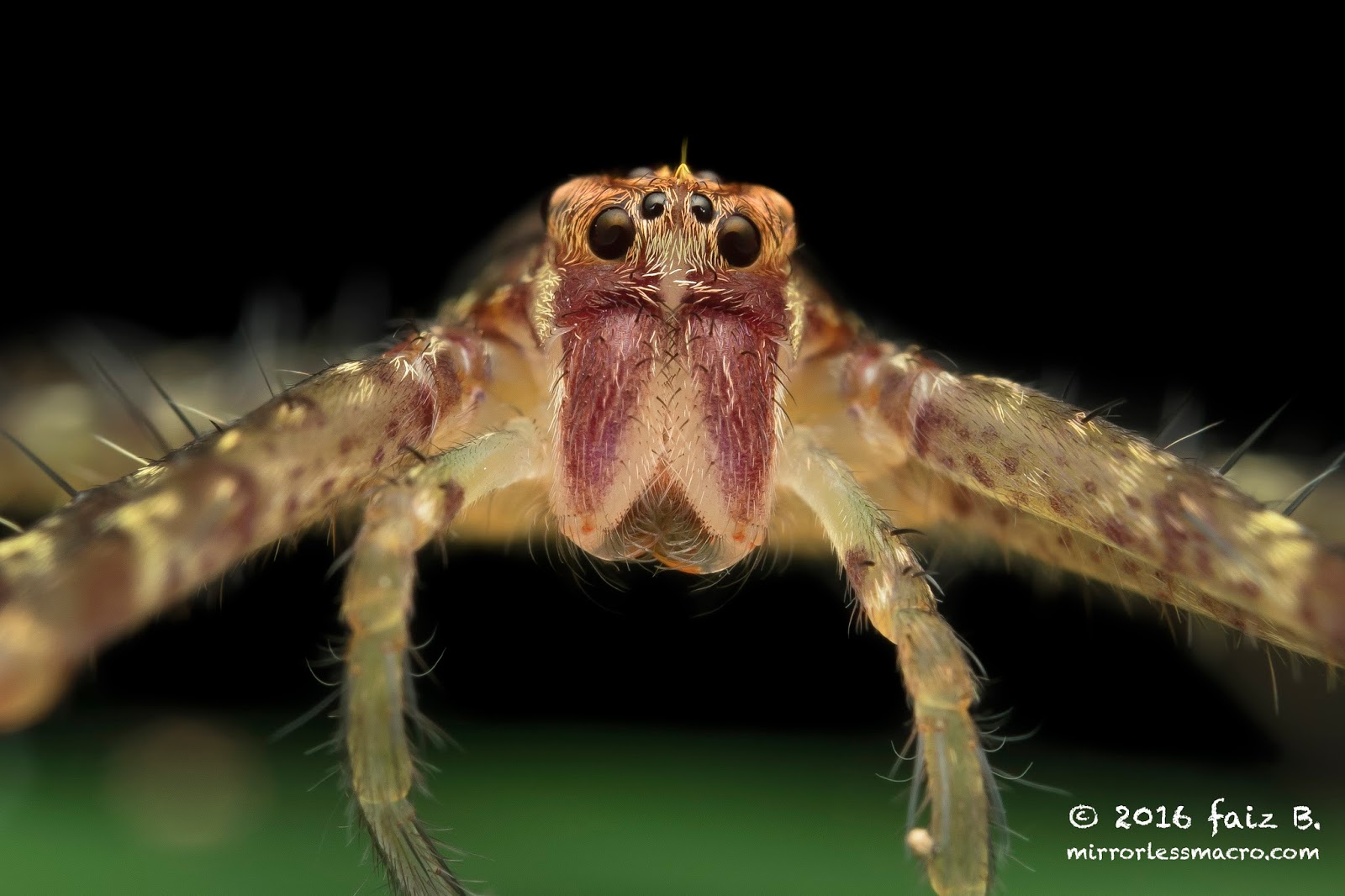
Psechridae? Freshly moulted, with a legspan of about 20mm.

The closest thing we have to a Peacock Spider, here in Singapore. Siler cf. semiglaucus, Male.

An intimate look at a Telamonia sp., carefully attending to her precious eggs.

Another look at the Male Bathippus sp.

A juvenile Cocalus sp. looking very pretty. This species is pretty unique because unlike most jumpers under the Salticidae Family, the Anterior Lateral Eyes (ALE) is positioned lower then the Anterior Median Eyes (AME)!

Close-up of a Ctenus cf. floweri, a species of Wandering Spider commonly found on the forest floor.

An unidentified Jumping spider.

Close-up of another very pretty Mangrove-dwelling jumping spider; Cosmophasis sp.

One of my favourite species with a funky hairdo! Here is a Mature Male Epeus flavobilineatus.

A Male Sword-Bearing Jumper (Thorelliola ensifera) with a legspan of about 4mm. Check out the 'horns' on its clypeus!


The Giant Bronze Jumper (Carrhotus cf. forsulatus)

A backlit Scorpion-tailed spider (Arachnura sp.)

Close-up of a Mature Male Cocalus sp.

Rhomphaea sp.

The last time I found a Cyriopagopus schiodtei in the wild was in 2013 in Pahang, Malaysia, where my late Grandfather was originally from. Capable of reaching a legspan of 8 inches, this arboreal (tree-dwelling) tarantula, locally known as "Labah-Labah Hutan", preys on anything that it can overpower, from small snakes to Towkay geckos. Believe it or not, we have a similar-looking arboreal tarantula (Lampropela violaceopes) that can be found in the forest of Singapore, and it measures 9 inches full grown!

Another Epeus species, probably Epeus cf. sumatranus.

A mature male Phaeacius malayensis.

A mature male Pancorius cf. petoti.

Harmochirus sp., commonly known as "Popeye Spider" for their disproportionately-large front legs, are pretty hard to spot in the wild due to the minute size and habitat. These jumping spiders can be seen amongst the leaf litter, and are often mistaken for ants. Finding one in its tiny home (and subsequently a few other nests) was such a pleasant surprise, confirming that they are indeed a specialised ground-dwelling species, living and feeding off the forest floor.

A flattened Pandercetes sp., commonly known as the Lichen Huntsman.

A juvenile Eight-Spotted Crab Spider (Latythomisus octomaculatus). Very rarely seen!

Back view of a Wraparound spider (Dolophones sp.)

A wide-angle shot of a Male Hyllus diardi in its natural habitat. Shot taken with an OMD EM1 Body, Samyang 7.5mm lens, and a Meike MK 302 flash with DIY Diffuser.

An unidentified Hunstman spider from West Malaysia, most probably Heteropoda sp.

A highly cryptic mud-mimic spider (Cryptothele sp.) that isn't the usual brown but green in color. This spider was probably less than 5mm in length and since depth-of-field is a problem at this magnification and size, I had no choice but to focus stack 2 images.

A female (?) Ligurra cf. latidens, another species of Mangrove-dwelling jumping spider.

A male Ligurra cf. latidens

Seldom-seen perspective of an Ogre-faced Net Casting Spider (Deinopidae) that clearly shows 2 horn-like structures directly above the larger Anterior Median Eyes. This particular specimen had a body span of about 20mm.

Meet the World's Largest Jumping Spider! A Mature Male Hyllus cf. diardi

Another shot of a Mature Male Phaeacius malayensis.

A gravid Plexippus cf. paykulli.

A beautiful female Telamonia cf. dimidiata

Dorsal shot of a Male Thiania bhamoensis

Portrait shot of a Male Thiania bhamoensis

Pristobaeus sp. - Unlike the other 'Wide-Jawed' Jumping Spiders like Bathippus sp. and Viciria sp., this Genus is officially unrecorded here in Singapore. It is quite common in Malaysia but not here, with only one documented sighting from Mandai, last year.

Telamonia dimidiata, the "World Famous" Spider that is a product of a silly Urban Legend. Since 1999, this spider has been the subject of an email hoax xlamining that it was a fatal spider found lurking under toilet seats in North Florida. This is absolutely ridiculous considering that:
1) Jumping spiders, or 99% of ALL Spiders for that matter, are harmless and don't go around biting people for a laugh. Even for those that possess medically significant venom, you would have to be extremely unlucky to get bitten because they would rather flee and hide that have to deal with you.
2) This spider is from the other side of the World!


Female Viciria cf. praemandibularis


Thwaitesia sp., commonly known as the Mirror Spider from the Theridiidae Family. As its common name suggests, they have mirror-like reflective scales on their abdomen that can change size depending on how threatened they feel.

A beautiful female Telamonia cf. dimidiata

Dorsal shot of a Male Thiania bhamoensis

Portrait shot of a Male Thiania bhamoensis

Pristobaeus sp. - Unlike the other 'Wide-Jawed' Jumping Spiders like Bathippus sp. and Viciria sp., this Genus is officially unrecorded here in Singapore. It is quite common in Malaysia but not here, with only one documented sighting from Mandai, last year.

Telamonia dimidiata, the "World Famous" Spider that is a product of a silly Urban Legend. Since 1999, this spider has been the subject of an email hoax xlamining that it was a fatal spider found lurking under toilet seats in North Florida. This is absolutely ridiculous considering that:
1) Jumping spiders, or 99% of ALL Spiders for that matter, are harmless and don't go around biting people for a laugh. Even for those that possess medically significant venom, you would have to be extremely unlucky to get bitten because they would rather flee and hide that have to deal with you.
2) This spider is from the other side of the World!

Male Viciria cf. praemandibularis

Female Viciria cf. praemandibularis


Thwaitesia sp., commonly known as the Mirror Spider from the Theridiidae Family. As its common name suggests, they have mirror-like reflective scales on their abdomen that can change size depending on how threatened they feel.
Update: My next post would probably be based on my upcoming overseas expedition happening at the end of July, where I spend a couple of days finding a rare and extremely gorgeous spider. Stay Tuned!


